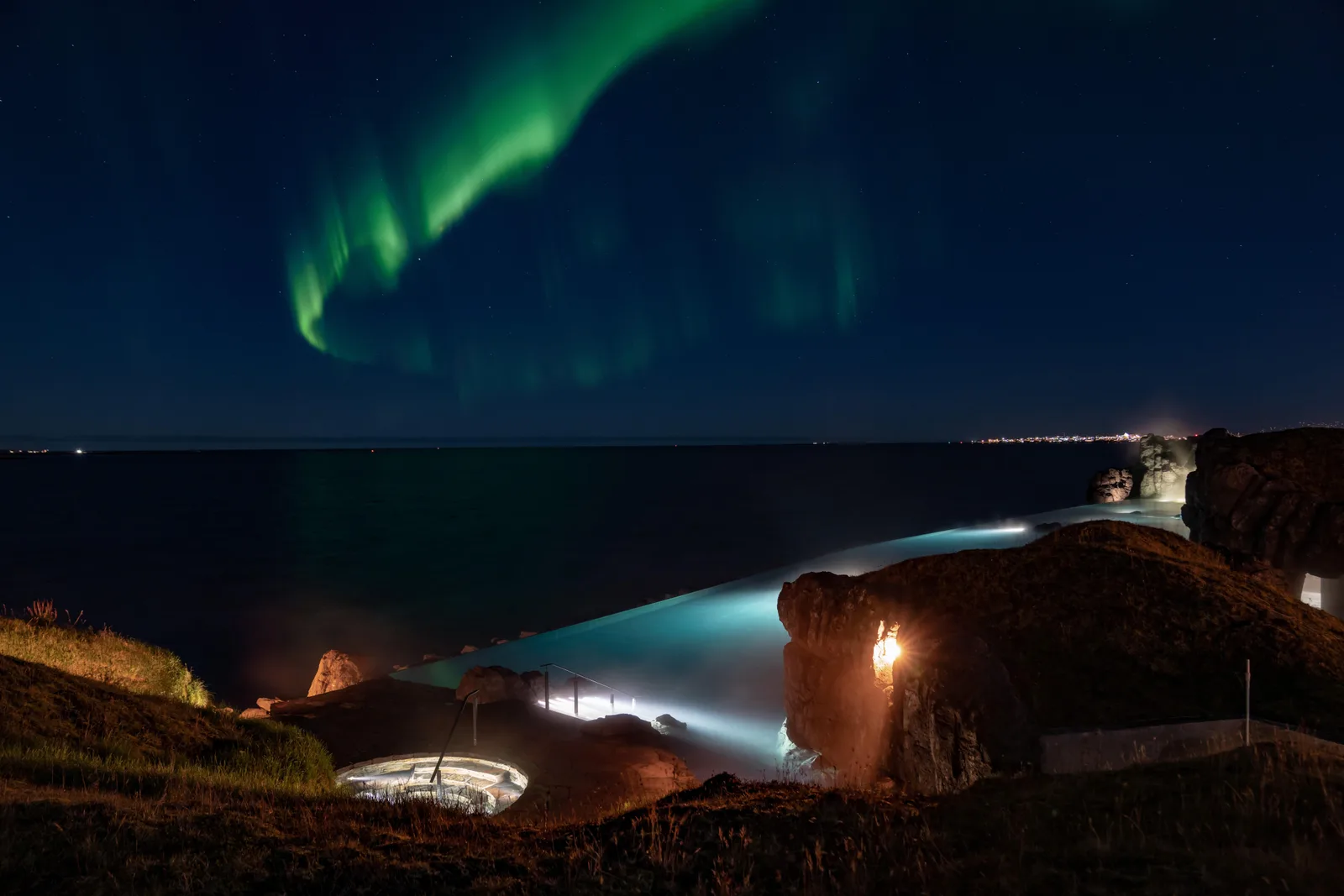
Seeing the aurora borealis dance over Iceland is, for many travellers, the whole reason to come. The good news: there is no better window in over a decade than right now. The catch: the lights are a natural phenomenon, so timing, location and a little patience all matter. This guide covers exactly when and where to look — and how to give yourself the best possible chance.
The short answer
The northern lights are visible in Iceland from roughly late August/September through mid-April, whenever the sky is dark and clear. The single best months are September and March, which pair long-enough nights with milder weather and an extra burst of activity around the equinoxes. On any given night, the lights are usually at their best between about 10:30 PM and 1:00 AM.
Why 2026–2027 is an exceptional season
The aurora is driven by the sun, which runs on a roughly 11-year cycle. The current cycle, Solar Cycle 25, peaked around 2024–2025, and forecasters expect solar activity to stay elevated through 2026 and into 2027 before gradually winding down toward the early 2030s.
In plain terms: stronger geomagnetic storms are reaching Iceland far more often than in a quiet year, so notable displays can appear several times a month when skies are clear. If catching the aurora is on your list, the next couple of winters sit in a genuine sweet spot — high activity and long Icelandic nights.
The best months, broken down
You can't see the aurora in Iceland's summer — the midnight sun keeps the sky too bright. Within the dark season, each month has a different character:
- September — One of the two best months. Nights are dark enough, the weather is relatively mild, and the autumn equinox boosts activity. A favourite for travellers who don't love deep-winter cold.
- October — Longer dark nights than September with still-reasonable weather; a strong, slightly under-rated choice.
- November–January — The deepest darkness of the year (December has up to ~20 hours of night), so the viewing window is huge. The trade-off is colder, often cloudier weather and icy roads.
- February–early March — Dark nights plus improving weather and the spring equinox surge. Late February and March offer some of the most stable viewing windows of the whole season.
- March — The other standout month, for the same equinox reason as September.
The equinox effect: Geomagnetic storms tend to peak around the spring and autumn equinoxes — a quirk of how Earth's magnetic field lines up with the solar wind. Aurora activity in March–April and September–October runs noticeably higher than in mid-winter, which is why those shoulder months punch above their weight.
The best time of night
Darkness is non-negotiable, so head out well after sunset. The aurora can technically appear any time the sky is dark, but the most reliable window is roughly 10:30 PM to 1:00 AM. In deep winter, with darkness arriving early, strong displays can show up earlier in the evening too. Avoid dawn and dusk, when residual light washes faint auroras out.
What you actually need to see them
Three things have to line up:
- Darkness — the darker the sky, the better. Get away from city lights.
- Clear skies — clouds are the number-one aurora killer. A modest display under clear skies beats a strong one hidden behind cloud.
- Solar activity — measured by the Kp index (a 0–9 scale of geomagnetic strength).
Because Iceland sits so far north, you don't need a high Kp number. Even Kp 2–3 can produce a beautiful show on a dark, clear night, and Kp 4+ often means a strong one. The takeaway most people get wrong: chase clear skies, not big Kp numbers.
How to check: Use the Icelandic Met Office aurora forecast (vedur.is) for combined cloud-cover and activity maps, and an aurora app for real-time alerts. Watch the cloud forecast even more closely than the Kp.
Where to see the northern lights
The golden rule is get away from light pollution and find a clear view of the northern sky.
- Near Reykjavík: You can sometimes catch the aurora from the city on a strong night, but light pollution dims it significantly. Better nearby options include the Grótta lighthouse on the edge of Reykjavík, or a short drive out of town.
- Top spots within reach of the capital: Þingvellir National Park (part of the Golden Circle), the Snæfellsnes Peninsula, and the south-coast countryside all offer dark skies and dramatic foregrounds.
- Further afield: Jökulsárlón glacier lagoon is a bucket-list aurora backdrop.
Watching from a geothermal spa
One of the most memorable ways to see the lights is from the warm water of a geothermal lagoon on a clear winter evening. Sky Lagoon, on the oceanfront edge of Reykjavík, opens onto a wide, dark ocean sky — on a clear winter night with enough solar activity, you can watch the aurora while you soak. Combining an evening Skjól ritual with a bit of aurora luck is one of the most magical things you can do in Iceland. It's never guaranteed, but few experiences beat catching a display while you're up to your shoulders in 38°C water. (See our complete Sky Lagoon guide and how to get there from Reykjavík.)
Beyond the aurora: other experiences while you wait
Iceland's winter itinerary has plenty to fill the daylight hours while you wait for a clear night. The Golden Circle day trip is the classic — Þingvellir National Park, the erupting Strokkur geyser, and Gullfoss waterfall, all doable in a day. The South Coast offers black-sand beaches and thundering waterfalls. And on any evening, a soak at the Sky Lagoon is a wonderful way to unwind and keep an eye on the sky. Browse the top-rated tours and activities below.
How to maximise your chances
- Stay several nights. The biggest factor in success is simply giving yourself more chances. A single night is a gamble; four or five nights dramatically improves your odds.
- Be ready to move. Conditions can flip quickly. If the forecast lines up, head out — even late.
- Consider a guided tour. Aurora tours use live forecasts to chase clear skies, and many offer a free re-join if the lights don't show on your first attempt.
- Self-drive carefully. Renting a car gives you flexibility, but winter roads are icy and dark — park only in designated areas, never on the roadside.
- Watch the moon. A bright full moon can wash out faint auroras, though it beautifully lights up snowy landscapes for photos.
What to wear and bring
Aurora hunting means standing still outdoors, late, in the cold. Dress in warm layers, with waterproof outerwear, insulated boots and gloves. Bring a tripod and spare camera batteries (cold drains them fast), a thermos, and patience.
Quick photography tips
- Use a tripod and a 2–10 second exposure.
- Set a wide aperture (low f-number), ISO 800–3200, and manual focus to infinity.
- Shoot in RAW if you can, and frame an interesting foreground — water, mountains or a lighthouse adds scale to the display.