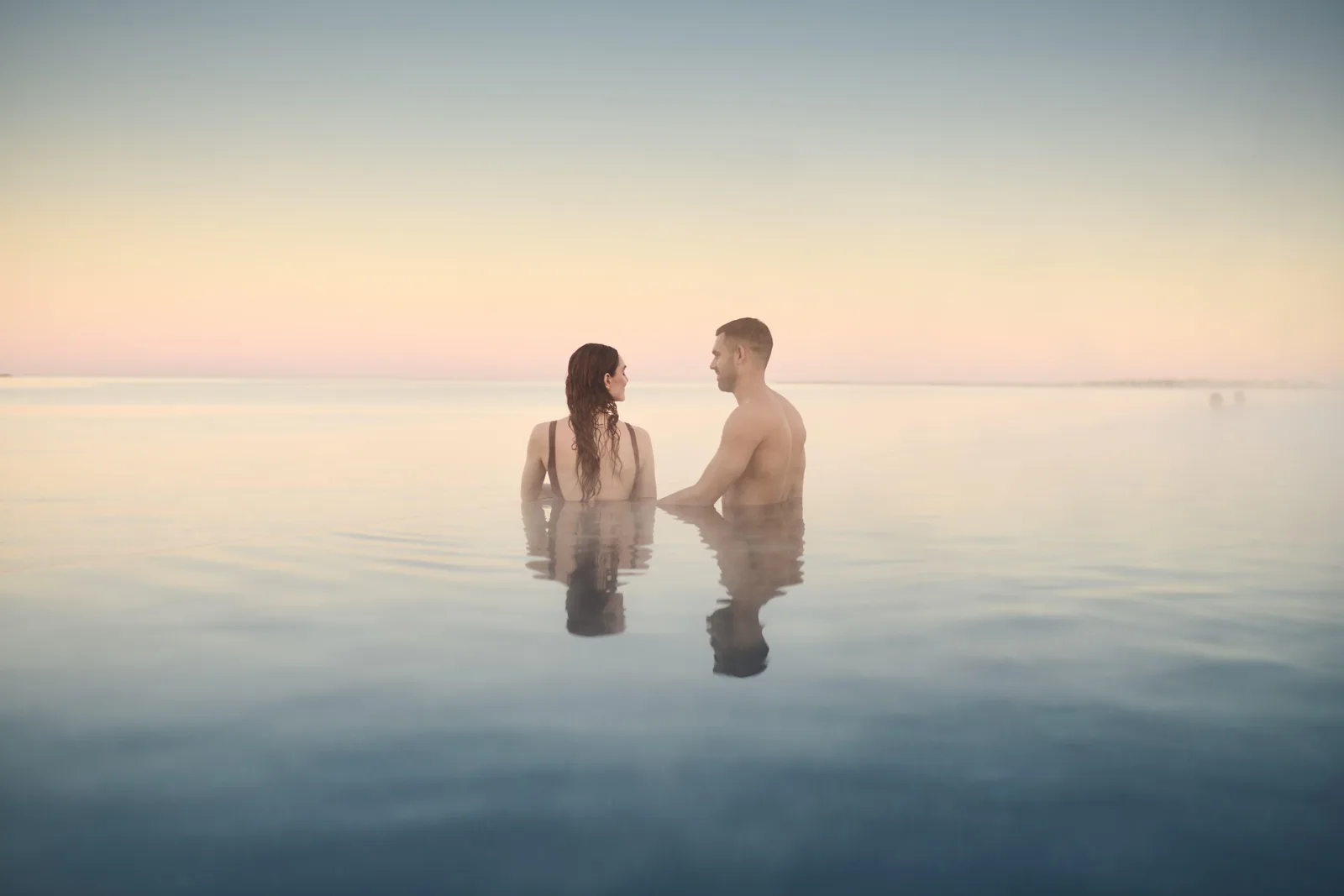
It's one of the most common questions for anyone planning a trip to Iceland: Sky Lagoon or Blue Lagoon? Both are world-class geothermal spas, both are unforgettable — but they offer genuinely different experiences, sit in different parts of the country, and suit different kinds of trips. This guide lays out the real differences so you can choose with confidence (and decide whether it's worth doing both).
The short answer
- Choose Sky Lagoon if you're based in Reykjavík, want a dramatic oceanfront setting and the seven-step ritual, value being close to the city, and prefer a calmer, more adult-leaning atmosphere — usually at a lower price.
- Choose Blue Lagoon if you want the iconic, bucket-list milky-blue water and silica mud masks, don't mind the drive out to the Reykjanes peninsula, and are happy to pay more for the most famous spa in the country (with luxury hotel and dining options).
Many visitors who have time do both — they're different enough to justify it.
At a glance
| Sky Lagoon | Blue Lagoon | |
|---|---|---|
| Location | Kópavogur, edge of Reykjavík | Reykjanes peninsula, near Grindavík |
| Distance from central Reykjavík | ~7 km (~13 min) | ~50 km (~45–50 min) |
| Distance from Keflavík Airport | ~45–50 min | ~20 min |
| Water | Geothermal, clear, oceanfront — no silica residue | Mineral-rich, milky silica-blue — dries hair without conditioner |
| Signature feature | Infinity edge + 7-step Skjól ritual (expanded Aug 2024) | Silica mud masks + iconic blue water |
| Minimum age | 12+, strictly enforced | 2+ (children 11 and under 2,000 ISK; max two children per adult) |
| Cold plunge | Yes, ~5°C, built into the ritual | No dedicated cold plunge at the main lagoon |
| Atmosphere | Calmer, adult-leaning | Larger, busier, iconic |
| Price | Lower; simple two-pass system | Higher; multiple tiers up to luxury |
| On-site hotel & dining | No hotel; casual café + tasting bar | Silica & Retreat hotels; Moss — 1 MICHELIN Star (2026) |
| 2026 volcanic risk | Negligible — outside the eruption zone | Real — active Sundhnúkur corridor, next eruption rated "likely" |
Sky Lagoon entrance pass
Oceanfront infinity edge + the 7-step Skjól ritual. From $117 · free cancellation.
Official Blue Lagoon Comfort admission
The iconic milky-blue water, a silica mask, drink and towel. From $150 · free cancellation.
Location and getting there
This is the biggest practical difference. Sky Lagoon is right on the edge of Reykjavík in Kópavogur — about a 13-minute drive from downtown, with free parking and easy shuttle, bus and taxi options. You can soak in the evening and be back at your hotel for dinner.
Blue Lagoon is out on the Reykjanes peninsula, roughly 45–50 minutes from Reykjavík but only about 20 minutes from Keflavík Airport. That airport proximity is its trump card: many travellers visit on the way to or from their flight, turning a layover-adjacent stop into a highlight. If you're not flying in or out that day, though, it's a longer round trip.
Verdict: Sky Lagoon wins on city convenience; Blue Lagoon wins as an airport bookend. For the Sky Lagoon routes in detail, see how to get to Sky Lagoon from Reykjavík.
The water and the experience
The two spas look and feel quite different in the water.
Sky Lagoon has clear geothermal water — no silica, no residue, no need to condition your hair beforehand — and a striking infinity edge that merges with the North Atlantic. Its defining feature is the seven-step Skjól ritual (lagoon, cold plunge, sauna, cold mist, body scrub, steam and a crowberry elixir), included free with every ticket. The ritual was expanded in August 2024 with a second sauna (Ylur) and the closing crowberry-elixir step (Saft), so it's a richer sequence than it was a couple of years ago. (See our full 7-step ritual guide.)
Blue Lagoon is famous for its milky, silica-rich blue water set in a black lava field — one of the most recognisable images in all of Iceland. The signature experience is a free silica mud mask at the in-water mask bar, with algae, lava-scrub and mineral masks unlocked on higher tiers, plus bookable in-water massage. Worth knowing before you go: the silica genuinely dries hair (soak in the free conditioner and leave it in), and there's no dedicated cold-plunge pool at the main lagoon — a real point of difference from Sky Lagoon's included cold-plunge step. Blue Lagoon has also added new sauna, steam-cave and locker facilities across 2024–2025.
Verdict: Different flavours. Sky Lagoon is about the ocean view, the included ritual and hair-friendly water; Blue Lagoon is about that unmistakable blue water and the mud masks.
Price
Sky Lagoon keeps it simple with two passes — Saman (public changing) and Sér (private changing) — ISK 14,990 for Saman and ISK 17,990 for Sér (about $130–160) depending on the tier and time slot, both including the full ritual and a towel. This generally comes in at a lower price point, which is part of its appeal for Reykjavík-based visitors.
Blue Lagoon runs a tiered system — Comfort, Premium and Signature start from roughly ISK 11,990 / 14,990 / 18,490 (about $86–150) — plus the ultra-luxury Retreat Spa (suites and a private lagoon, from around ISK 89,000) and the Silica and Retreat hotels. Both venues use dynamic pricing that moves with the date and time slot, so treat any headline figure as a floor rather than a fixed price, and factor in transfer costs — Blue Lagoon's 45–50 minute journey from Reykjavík adds more to your total than Sky Lagoon's 13-minute hop.
Always check current rates when you book. As a rule of thumb, Sky Lagoon is the more budget-friendly of the two once transfers are included.
Atmosphere and crowds
Sky Lagoon leans calmer and more grown-up — it's designed as a relaxing, contemplative space, and its 12+ minimum age keeps the vibe serene. Capacity is capped (around 550 lockers), so even busy afternoons stay "busy but never packed." Blue Lagoon is Iceland's single most-visited paid attraction, welcoming up to around 4,000 guests a day; pre-booked timed entry prevents genuine overcrowding, but the mask bar, swim-up bar and changing rooms do get busy, especially 10:00–15:00. Many visitors note Sky Lagoon feels a touch more local and less crowded.
Verdict: Sky Lagoon for tranquillity; Blue Lagoon for the famous spectacle.
Food, drink and extras
Both let you order a drink without leaving the water, with a three-alcoholic-drink limit per adult at each. Sky Lagoon has the in-lagoon Gelmir Bar, the Smakk Bar (Icelandic tasting platters) and Keimur Café — casual, well done, no fine dining. Blue Lagoon goes much further: four dining venues up to Moss (holder of a MICHELIN Star in the 2026 Guide), two on-site hotels (Silica and The Retreat, the latter with a MICHELIN Key), and bookable in-water massage and float therapy — so it's the better base for a multi-hour or overnight luxury experience.
Verdict: Sky Lagoon covers the essentials elegantly; Blue Lagoon is the one to pick if you want a full destination-resort day (or stay).
A note on volcanic activity (and reliability)
Because it's a real planning factor in 2026, it's worth being clear-eyed about it. Blue Lagoon sits inside the active Sundhnúkur volcanic corridor on the Reykjanes peninsula, roughly 3–5 km from a crater row that has erupted nine times since December 2023. It has been evacuated or closed at short notice for most of those eruptions — usually for a few hours to a few weeks — and in November 2024 lava reached the site itself, destroying the original car park (the lagoon and hotels were protected by engineered lava barriers). The most recent eruption ran 16 July–5 August 2025.
As of this update (checked 10 August 2026), both lagoons are open and operating normally. But it's worth knowing that Iceland's Meteorological Office currently holds the Svartsengi system at "Orange — Heightened Unrest," with more magma accumulated beneath it than at any prior point in the entire eruption series, and rates a further eruption as the most likely scenario — arriving with as little as 20 minutes to a few hours' warning. Blue Lagoon's response has matured with each event: the July 2025 closure was a same-day evacuate-and-reopen, and if it does close for volcanic activity, Blue Lagoon offers a full refund or free rebooking.
Sky Lagoon, in Kópavogur next to Reykjavík, is well outside that hazard corridor and has never had an eruption-related closure. If guaranteed reliability matters for a tightly scheduled trip — especially a single departure-day slot — that's a genuine point in Sky Lagoon's favour. (Reykjavík, Keflavík Airport and the Ring Road have all stayed unaffected throughout, so this is about the Blue Lagoon site specifically, not Iceland as a whole.)
Always check the official status of whichever spa you book close to your visit — via the operator's own site or Iceland's safetravel.is advisories.
Which should you choose?
- Short city break in Reykjavík, no car: Sky Lagoon — closer, cheaper, easy transfers.
- Arriving or departing via Keflavík with time to kill: Blue Lagoon — it's right by the airport, with on-site luggage storage.
- Travelling with children under 12: Blue Lagoon — Sky Lagoon simply won't admit them (minimum age 12); Blue Lagoon accepts age 2+, with admission for children 11 and under at 2,000 ISK and a maximum of two children per adult.
- Want the most iconic photo and the mud masks: Blue Lagoon.
- Want an oceanfront infinity edge, an included cold plunge and a calmer scene: Sky Lagoon.
- Travelling on a budget: Sky Lagoon — once you factor in Blue Lagoon's longer, pricier transfer.
- Want a luxury overnight spa stay or Michelin-level dining: Blue Lagoon (The Retreat, Moss).
- Tight schedule, want zero risk of volcanic disruption: Sky Lagoon.
Can you do both?
Yes — and plenty of people do. They're different enough that one doesn't spoil the other, though each realistically needs 2–4 hours including changing, so doubling up on the same day makes for a long, waterlogged one. The cleaner plan: do Blue Lagoon on your Keflavík arrival or departure day, using its airport proximity and luggage storage, and save Sky Lagoon for an evening soak during your Reykjavík stay. Spreading them across separate days also works as a hedge — if a Reykjanes eruption ever closes the Blue Lagoon on you, Sky Lagoon is unaffected.