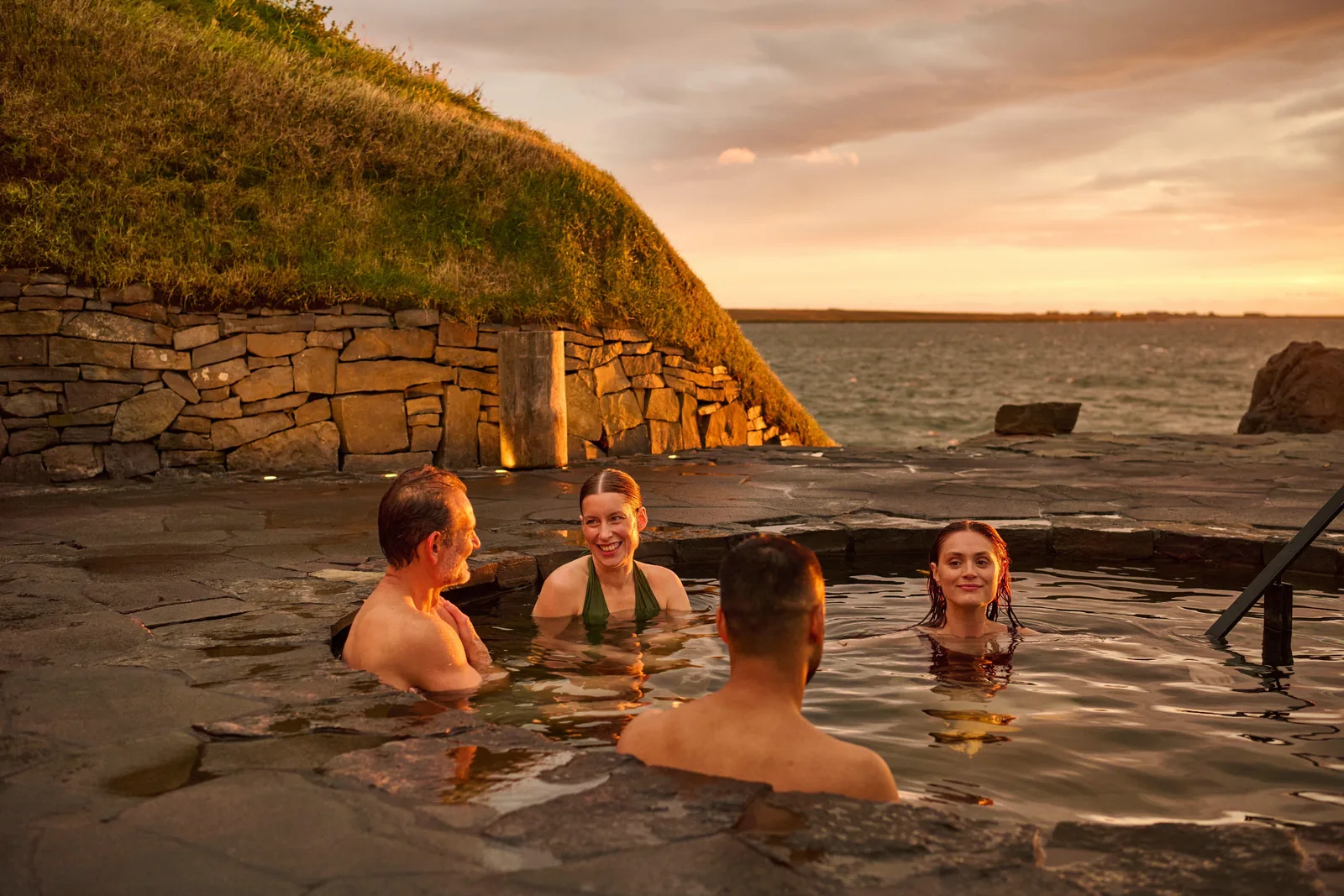
The short answer
There is no bad season for Sky Lagoon. It opens every day of the year, including Christmas and New Year, though the hours change with the season. The water temperature changes very little; what changes is whether your visit lands in daylight, at sunset or after dark.
If you want sunset followed by a dark evening, late September and October are particularly good — book about an hour before sunset so you are already in the water as the light goes. From late September until the end of February an evening visit also brings the possibility of northern lights, if the sky is clear and the aurora obliges. In May, June and July sunset comes too late to plan around, so take a late slot for the long bright evening instead. From November to January sunset is early enough that you can choose: mid-afternoon for the sunset itself, or later for a soak under a properly dark sky.
Guests leave the lagoon 30 minutes before the published closing time, and the seven-step ritual closes an hour before the lagoon does, so build both into your arrival time. If Sky Lagoon is part of a wider Iceland trip, there is little reason to pick your travel month around the lagoon. Choose the season for the rest of the itinerary, then let sunset and the opening hours pick your slot.
- Sunset and then darkness
- September–October, ~1 hour before sunset
- A chance of northern lights
- Mid-Sep–early Apr, evening
- A bright summer-evening soak
- May–July, late evening
- Winter sunset
- Mid-afternoon
- A dark winter soak
- Evening
- Time for the ritual unhurried
- Arrive 1½–2 hours before closing
- A bad forecast, 1–10 guests
- Change or refund, 24h notice
- Sunset, mid-October about 18:10
- Sunset, mid-December about 15:30
- Lagoon hours, 21 August to 20 October 9am–10pm
- Out of the water, and ritual closes 30 min / 1 hour before closing
Check dates and time slots Free cancellation · the calendar shows which slots are still open
What your date gives you
Opening hours, sunset, and how long the sky is dark before you have to leave the water. Times are Iceland local time, which is UTC all year.
15 October: the lagoon is open 9am to 10pm on the autumn band and you must be out of the water by 21:30. Sunset is at 18:09, which falls while you can still be in the lagoon. The sky is dark enough for the aurora from 19:52, leaving about 98 minutes of dark sky before you get out, though you would still need a clear night. Aim to arrive around 17:15, an hour before sunset.
- Lagoon hours 9am to 10pm, autumn band
- Out of the water by 21:30
- Seven-step ritual closes 21:00
- Sunrise / sunset 08:18 / 18:09
- Dark sky before you leave about 98 minutes, from 19:52
- Suggested arrival 17:15
Conditions: showing the 30-year average for Reykjavík, because this date is more than 16 days ahead. Average daily high 7.6°C, 80 mm of rain across the month, mean wind 4.4 m/s, and cloud covering about 71% of the sky.
See slots for this date The calendar knows which slots are left; this card knows what the sky will be doing.
Choosing your Iceland dates
For most visitors Sky Lagoon is one part of a wider Iceland trip, so it makes sense to choose the travel season for what you want to do elsewhere in the country. June to August brings the longest days, the easiest road-trip conditions and the widest choice of summer activities. September to March is the better half of the year if the northern lights are a priority, and winter adds snow, short days and a higher chance of weather disruption.
Sky Lagoon works in all of them. Once your Iceland dates are fixed, the more useful decision is what time of day to book — sunset, a bright summer evening, or a dark winter soak.
Sunset from the water, month by month
The lagoon points west-north-west across Faxaflói bay from the tip of the Kársnes headland, which is why the sunset is the thing most people ask about. Whether you can watch it from the water is decided entirely by the date, and it turns on a house rule: guests are asked to leave the lagoon 30 minutes before closing.
Put that rule next to the sun and the year splits in two. In late December the sun goes down at 15:30 and you can stay in the water until 20:30, so the sunset is almost impossible to miss. By the first week of April sunset has moved past 20:30, and from then until the start of August it happens after you are already out of the lagoon. Around the June solstice the sun sets at about 23:58 and the lagoon closes at 11pm, so nobody is in the water for it.
So from late spring through much of the summer, sunset comes too late to plan a visit around. What those months give instead is the reverse: from late April to mid-August the sky never gets properly dark at all, and an 8pm slot is a soak in broad daylight with the lagoon open until 10pm or 11pm. Reykjavík sits about 272 km south of the Arctic Circle, so this is not a true midnight sun — the sun does set, just after the lagoon has shut.
The best-lit months for a sunset in the water are the ones where it lands mid-evening instead of mid-afternoon. In September the sun goes down at 19:56, in October at 18:10 and in February at 18:00, all comfortably inside opening hours and late enough to feel like the end of the day instead of the middle of it.
One genuine extra, on a clear day: Snæfellsjökull sits 117 km away on a bearing of 312 degrees, and the sun only goes down behind the glacier for a few days around the start of May and the start of August. Of those two windows, only the August one falls inside the hours you may be in the lagoon. Sky Lagoon's own page calls it one of the few things in life as mesmerizing as watching the sun set behind Snæfellsjökull, and it does need a clear evening.
When the sky is dark before the lagoon closes
Iceland's aurora season is usually quoted as September to April. That is true of the country and too generous for this lagoon, because the aurora needs a properly dark sky and the lagoon closes before the sky gets there for a good part of that window.
Taking darkness as the point where the sun sits 12 degrees below the horizon — the threshold at which an aurora can show against the sky — and setting it against the published closing times, the window runs from about 19 September to 1 March. Midwinter gives the most of it: in mid-December the sky is dark from about 17:57 and you can stay in the water until 20:30. By mid-October there is comfortably time for the sunset and then full darkness in a single evening visit. Both ends of the window are thin, down to a few minutes in the second half of September and again at the very start of March.
Either side of that, the arithmetic runs out. From 2 March to 18 September the sky either reaches that darkness only after guests have been asked to leave the water, or never reaches it at all — from late April to mid-August there is no such darkness on any night.
A dark sky is what the date can give you, and it is only the first of three things an aurora needs. The other two are a clear sky and geomagnetic activity on the night, and neither is something a month can promise: mean cloud cover at the Reykjavík station sits between 71% and 76% of the sky in every single month of the year, so no month here is reliably clearer than another. Sky Lagoon also sits at the edge of the capital region, so there is city light in the sky. Treat an aurora over the lagoon as a possible bonus in those months, not as a reason to pick one. If seeing them is the point of the trip, our guide to the best time for the northern lights in Iceland covers the hunt properly.
Opening hours by season
Sky Lagoon publishes four bands and keeps to them, and there is no date in the year on which the lagoon is closed.
| Season | Dates | Hours | Out of the water by |
|---|---|---|---|
| Winter | 21 October to 30 April | 10am to 9pm | 20:30 |
| Spring | 1 May to 20 June | 10am to 10pm | 21:30 |
| Summer | 21 June to 20 August | 8am to 11pm | 22:30 |
| Autumn | 21 August to 20 October | 9am to 10pm | 21:30 |
Three of those bands step inside a calendar month, which matters if you are recommended a month and then book the end of it. October is the clearest case: the lagoon runs 9am to 10pm until the 20th and 10am to 9pm from the 21st, so you can be in the water until 21:30 in the first three weeks and 20:30 after that. June and August split the same way.
Four things close before the lagoon does, and the first is the one that catches people out. The seven-step ritual and the in-water Gelmir Bar shut a full hour before closing time; Keimur Café closes half an hour before; guests are asked to leave the lagoon 30 minutes before closing; and Smakk Bar, where the Icelandic tasting platters are, opens at noon, so an early-morning slot in high summer gets the café rather than the platters.
The public holidays are open days on different hours: 9am to 6pm on 24 December, 9am to 8pm on Christmas Day, 11am to 10pm on 26 December, 9am to 8pm on 31 December and 9am to 10pm on 1 January.
What the hour of your slot decides
You choose a date and then a time when you book, and the time is the half of that decision most guides skip. It settles three things.
Whether you are in the water for the light. A visit of an hour and a half to two hours, which is what the operator recommends, is short enough that arriving an hour after sunset means missing it entirely. Being in the lagoon roughly an hour before sunset is the rule that works in every month where a sunset is available at all, and in the dark months it also leaves you time to stay on until the sky goes properly dark.
The two are not the same arrival. In mid-December the sun goes down at 15:30 and the sky is not properly dark until 17:57, so a visit of the length the operator recommends reaches one or the other. Catching both means arriving in the early afternoon and staying about three hours, which you are free to do: there is no time limit once you are in.
Whether you get the whole ritual. The Skjól ritual is included with every pass, in seven steps: the lagoon itself at 38–40°C, a cold plunge at 5°C, a sauna at 80–90°C with windows onto the sea, an open-air mist at about 5°C, the body scrub, a steam room at 46°C and a crowberry elixir. It closes an hour before the lagoon. A slot within about ninety minutes of that cut-off means choosing between doing the ritual and lingering afterwards.
How much of the weather you actually meet. In 38–40°C water, rain is close to irrelevant and air temperature nearly so. Where the Icelandic weather lands is the two cold steps, which are outdoors by design: the plunge, and a mist the operator describes as the touch of Icelandic winds. The mean wind at the Reykjavík station runs 5.5 m/s in February against 3.5 m/s in July, and the average daily high 3.3°C against 14.9°C. That is the difference between those steps being bracing and being the reason you cut them short, and it is why the operator sells hats at reception.
The most useful rule the product itself gives you is the flexible one: a ticket bought in advance can be moved to another date, or refunded, on request. The notice you need depends on how many of you there are — 24 hours for a booking of ten or fewer, 72 hours for 11 to 25, and longer again above that. Because the lagoon opens in any weather, the sensible response to a bad forecast is to move the booking rather than write off the trip. Book it into the first days of a trip and you keep that option open.
Two ways to book it, depending on your hour
Entrance pass on its own
Right for a daytime or bright-evening slot, and for anyone driving. Parking at the lagoon is free with no time limit, and the drive from the city centre takes about 13 minutes.
See dates and slotsAdmission with a transfer
Worth it for a dark-season evening, when your slot ends after nightfall. The public route back involves two buses and a walk along the shore at Kársnes, which is a different proposition in December.
See dates with a transferMonth by month, with the figures
Sun times are for the 15th of each month at the lagoon's own coordinates. Temperature, rain, sunshine and wind are 30-year averages for the Icelandic Met Office station in Reykjavík, about four kilometres north.
| Month | Lagoon hours | Sunset, 15th | Dark sky before you leave | Average daily high | Rain | Sunshine | Mean wind |
|---|---|---|---|---|---|---|---|
| January | 10am–9pm | 16:19 | 119 min | 3.2°C | 87 mm | 23 h | 5.2 m/s |
| February | 10am–9pm | 18:00 | 42 min | 3.3°C | 91 mm | 62 h | 5.5 m/s |
| March | 10am–9pm | 19:27 | None; the lagoon closes first | 4.2°C | 81 mm | 110 h | 5.2 m/s |
| April | 10am–9pm | 21:00 | None; the lagoon closes first | 6.9°C | 59 mm | 165 h | 4.8 m/s |
| May | 10am–10pm | 22:35 | None; the sky never gets that dark | 10.1°C | 53 mm | 209 h | 4.4 m/s |
| June | 10am–10pm, then 8am–11pm from the 21st | 23:58 | None; the sky never gets that dark | 13.0°C | 43 mm | 189 h | 3.8 m/s |
| July | 8am–11pm | 23:26 | None; the sky never gets that dark | 14.9°C | 50 mm | 183 h | 3.5 m/s |
| August | 8am–11pm, then 9am–10pm from the 21st | 21:46 | None; the sky never gets that dark | 14.1°C | 65 mm | 165 h | 3.7 m/s |
| September | 9am–10pm | 19:56 | A few minutes from about the 19th | 11.4°C | 87 mm | 118 h | 4.4 m/s |
| October | 9am–10pm, then 10am–9pm from the 21st | 18:10 | 97 min | 7.6°C | 80 mm | 92 h | 4.4 m/s |
| November | 10am–9pm | 16:29 | 121 min | 4.6°C | 87 mm | 40 h | 4.9 m/s |
| December | 10am–9pm | 15:30 | 153 min | 3.3°C | 95 mm | 13 h | 5.1 m/s |
Two of those columns need a word of explanation. The rain and sunshine figures are both totals for the whole month, not a daily rate, so 80 mm in October is the month's rainfall added up and says nothing about how many days were wet. Read that way, the sunshine column collapses in a way the temperature never does: Reykjavík averages 209 hours of sunshine across May and 12.6 hours across the whole of December. Rain barely has a season here, running from 43 mm in June to 95 mm in December, and in a heated lagoon it is the least consequential figure on the table.
How busy is it?
Honestly: nobody publishes a figure that answers this. Sky Lagoon does not release visitor numbers, and no public series counts admissions by month, let alone by time slot. What exists is a regional indicator, worth quoting as long as it is labelled as one.
Statistics Iceland records overnight stays in all registered accommodation across the capital region. In 2025 that series ran from about 232,000 in January to about 418,000 in August, so August drew roughly 1.8 times January's figure. January was the lowest month, with December and April next, and July second-highest behind August.
What that series counts is people sleeping in the capital region. It cannot see day visitors, cruise passengers, Icelanders from Kópavogur and Reykjavík, or anyone stopping on the way to the airport, and it says nothing at all about which slots fill first. Read it as a guide to how much demand is in the city in a given month, and then let the booking calendar answer the question it can actually answer: which times are still available on your date.
How we know
Opening hours, the four seasonal bands, the holiday hours, the leave-the-water and ritual closing rules, the 38–40°C water, the ritual step temperatures, the recommended stay of an hour and a half to two hours, the minimum age of 12, the prohibition on swimming in the sea, and the policy on changing a booked time all come from Sky Lagoon's own pages, with the hours and the booking-change tiers re-read on the operator's opening-hours and terms pages on 13 September 2026. That entry is by booked time slot is taken from the operator's booking flow, which asks for a date and then a time.
Sunrise, sunset and the onset of darkness are computed with the NOAA solar-position algorithm at the standard 90.833° zenith for the lagoon's coordinates, 64.117°N and 21.946°W. They were cross-checked against MET Norway's sunrise service, which agreed to within two minutes on every date tested; a third public calculator ran five to seven minutes out at this latitude and was not used. Iceland stays on UTC all year and has no daylight saving, so there is no clock change to trip over. Darkness is taken as nautical twilight, the sun 12° below the horizon, which is a conventional threshold for a sky the aurora can show against.
Climate figures are 1991–2020 normals computed from the Icelandic Met Office's published monthly series for station 1, Reykjavík. The same parser reproduces the Met Office's own published 1961–1990 normals for that station, which is how the column mapping was checked before any figure here was used. Visitor figures are Statistics Iceland table SAM01601, overnight stays in all registered accommodation, capital region, 2025. The date checker's live conditions come from the Open-Meteo forecast API for the lagoon's coordinates.
Where this stops. These numbers cannot tell you how busy a given time slot will be: no hour-level count is published for the lagoon, so the page ranks the hours by light and by the ritual's closing time, which are published, and not by crowding, which is not. The visitor series is a proxy for regional demand and does not measure admissions. The climate station is about four kilometres from the lagoon and a headland is windier than a city station, so treat the wind figures as the shape of the year rather than a reading at the infinity edge. Sun times are computed, and are quoted to the minute and no finer; they shift by a minute or two from year to year, so the date checker and the month table will not always agree to the exact minute. Averages are not forecasts: a 7.6°C average daily high does not prevent a raw October evening. And a dark sky is necessary for the northern lights without being sufficient.
Timing a Sky Lagoon visit: common questions
What is the best time of day to visit Sky Lagoon?
From August to early April, aim to be in the water about an hour before sunset: that puts you in the lagoon while the light goes, and in the darkest months it leaves time to stay on until the sky is properly dark. From April to July the sun sets after you must leave the water, so there is no sunset to time your arrival against, and a late slot buys you the long bright evening instead. Either way, book earlier than you otherwise would if you want the seven-step ritual unhurried, because the ritual and the in-water Gelmir Bar shut a full hour before the lagoon does, and guests are asked to leave the water 30 minutes before closing.
Can you watch the sunset from Sky Lagoon?
For most of the year, yes. From around the start of April to the start of August the sun sets after the time guests are asked to leave the water, so the sunset happens once you are already out. Around the June solstice the sun goes down at about 23:58 and the lagoon closes at 11pm. From August through to early April sunset falls inside the hours you may be in the lagoon, and in November, December and January it falls in the afternoon.
Is Sky Lagoon a good place to see the northern lights?
It can be, from about 19 September to 1 March, and it is luck rather than a plan. That is the stretch when the sky reaches a darkness the aurora can show against before guests have to leave the water, though the first and last days of it give only a couple of minutes. From 2 March to 18 September the lagoon closes before the sky is properly dark, and from late April to mid-August there is no such darkness at all. You also need a clear sky and geomagnetic activity on the night, and the lagoon sits on the edge of the capital region, with city light in the sky. The operator puts it as testing your luck, which is the right expectation.
What are Sky Lagoon's opening hours?
Four published bands: 10am to 9pm from 21 October to 30 April, 10am to 10pm from 1 May to 20 June, 8am to 11pm from 21 June to 20 August, and 9am to 10pm from 21 August to 20 October. Guests are asked to leave the lagoon 30 minutes before closing, the seven-step ritual and Gelmir Bar close an hour before, Keimur Café half an hour before, and Smakk Bar opens daily at noon. There are separate hours on 24, 25, 26 and 31 December and on 1 January, and no day of the year on which the lagoon is closed.
Which months are quieter at Sky Lagoon?
Nobody publishes a visitor count for the lagoon itself, or for individual time slots, so this can only be answered indirectly. Statistics Iceland's figures for overnight stays across the capital region put January lowest in 2025, with December and April next, and August and July highest. Treat that as a guide to regional demand rather than a count of people in the water, and use the booking calendar to see which slots are still open on your date.
Can I change my Sky Lagoon booking if the forecast looks bad?
Yes. A ticket bought in advance can be changed to another date or refunded on request, and for a booking of ten or fewer the operator asks for at least 24 hours' notice. That is the single most useful thing to know about timing a visit here. Larger groups need more warning: 72 hours for 11 to 25 guests, 96 hours for 26 to 50, and longer again above that. Because the lagoon itself opens in any weather, moving the booking is usually better than cancelling it.